BLOG
In today's smart buildings, lighting means much more than simply turning lights on and off. This is where DALI comes in. So, what exactly is this DALI technology that lighting professionals frequently talk about?
DALI stands for "Digital Addressable Lighting Interface." In its simplest terms, it is a bidirectional communication protocol that enables lighting components (drivers, sensors, switches) to communicate with and be controlled by each other. Emerging in the late 1990s, this technology has become much more advanced and reliable with the current DALI-2 version (IEC62386 standard).
Older DALI versions could have compatibility issues between brands. However, DALI-2, managed by DiiA (Digital Illumination Interface Alliance), eliminated this problem by introducing mandatory certification processes. This means you can confidently use products from different brands that bear the DALI-2 logo on the same system.

While the 1-10V analog system is frequently compared in the industry, DALI is completely digital. We can summarize the difference as follows:
1. Communication: 1-10V can only say "turn off" or "turn on". DALI, on the other hand, can manage complex commands such as color changes, emergency lighting tests, and fault feedback.
2. Standard: In 1-10V systems, the dimming curve is not standardized; light levels may be inconsistent with different driver brands. In DALI, however, the dimming curve is standardized, and every device responds to the same command in the same way.
3. Flexibility: When your office layout changes, you need to disconnect and reconnect cables in a 1-10V system. With DALI, you can change which switch controls which light with a single click.
Another frequently asked question is: "I already have KNX in my building, why should I use DALI?"
KNX, LON, or BACnet are protocols designed for the overall management of a building (Heating, Elevators, Security). However, these protocols are cumbersome for directly connecting to LED drivers, and it is difficult to find suitable drivers on the market. Ideal Scenario: KNX or BACnet handles the building's overall management (BMS), while DALI takes on specific and sensitive tasks such as lighting. These two systems communicate via a "Gateway". For example, when the security system (KNX) detects a burglar, it can send a command to the DALI system to turn on all the corridor lights.
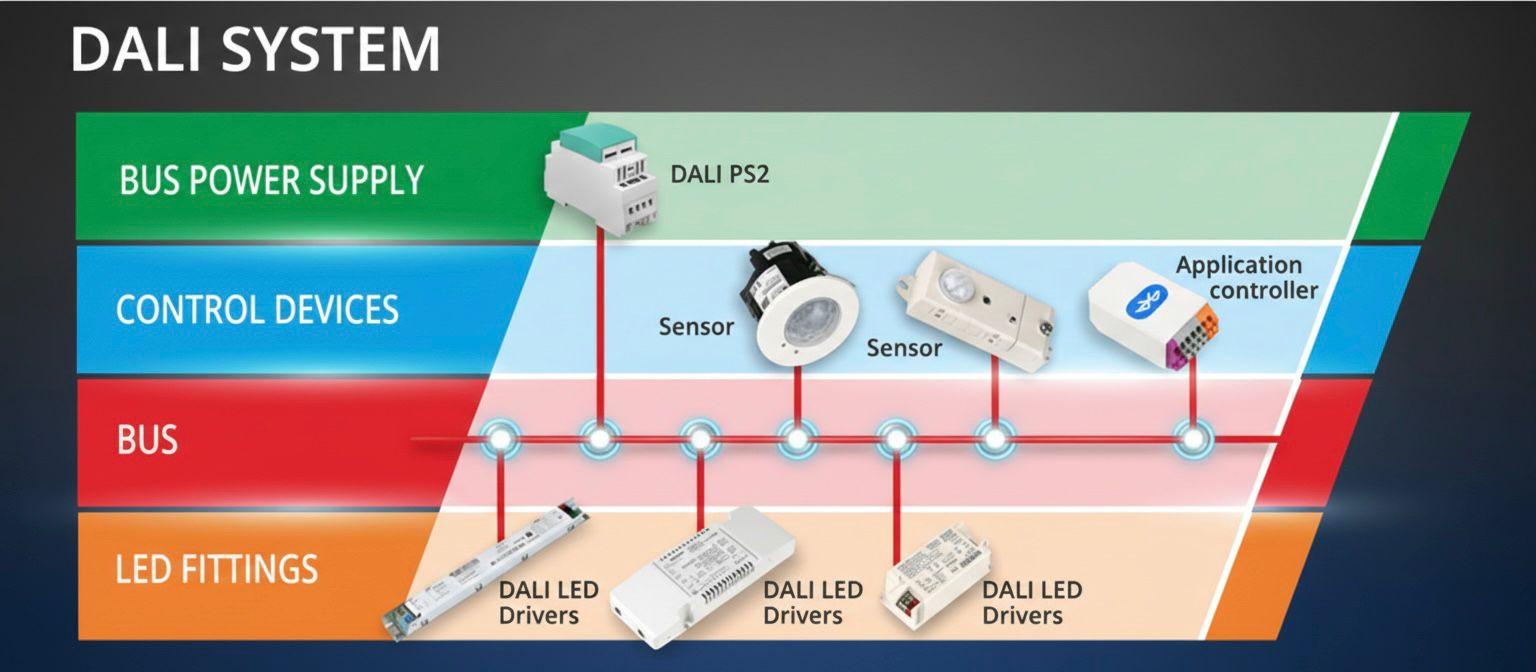
The heart of the DALI system is a two-wire bus line. The system consists of the following components:
1. Bus Power Supply (PSU): Maintains the voltage of the line (approximately 16V).
2. Application Controller: The brain of the system. It processes data from sensors and sends commands to drivers. Manages traffic conflicts. 3. Input Devices: Sensors and switches.
4. Control Gears (LED Drivers): Devices that receive the command and turn on the light.
Important Wiring Tips:
In summary,
DALI is a global standard in lighting control. The guaranteed compatibility, precise control, and ease of installation, especially with DALI-2, make it indispensable for modern buildings. If you are looking for flexibility and intelligent management in your project, DALI is the right solution.
OUR LATEST POSTS
© 2026 Pamir | All Rights Reserved.

 TR
TR
 DE
DE
 FR
FR
 AR
AR